Monday, January 24, 2011

Inventing the Wheel(bug)

Back in September, a good friend brought me two bugs he had found in Little Hocking, Ohio. He didn't know what they were, but figured that I would know something about them.

Eh, he was correct.

In fact, what he had found was a wheel bug, part of the assassin bug family, of the species Arilus cristatus. Two of them in fact, which was quite fortunate (one was a female, as I found out later when it laid an egg cluster). Wheel bugs are quite large: the wheel bug is one of the biggest true bugs in North America (1 inch to 1.25 inches in length), and, certainly in Ohio, is probably the biggest you're likely to find. If there are bigger true bugs (Hemiptera) in Ohio, I would love to find them. Female wheel bugs are bigger than males, as is the trend in the insect world. Wheel bugs range from Rhode Island to Nebraska, further west into California, and south into Florida and Texas. They've also been reported to be in Mexico and Guatemala, so if you find yourself down there, look around for them.

It actually has pretty good balance: it's keeping itself upright with only two of its legs. Thinking back to this moment, it could have been making an aggressive stance. If so, I dodged that bullet.

The most distinct feature of the wheel bug is also its namesake: the "cogwheel" on its back. Or chicken's comb, if you prefer. The wheelbug is the only insect in the United States with such a structure, and no one's quite sure what its use is. It's been speculated that it's useful for species recognition or to alert predators that it tastes bad, but from what I could gather from the published literature, no one has really bothered to study the wheelbug enough to figure out what function the cogwheel has. It's actually kind of embarrassing, not least of all because that's where the insect gets its common name from, and certainly something so unique and conspicuous deserves special attention. I don't buy either explanation, as they're both extremely lacking. If anything, it seems like it would serve to intimidate potential predators more than anything else. In my experience, it has had that effect on humans who have seen them. At any rate, it's a very interesting quirk that the bug has. The cog can have anywhere between 8 and 12 teeth on it, and the nymphs lack the crest. That must be an interesting molt.


The wheel bug has some interesting colors. The membrane on the wings reflects a bronze color, and its body is covered in fine yellow hairs (pubescence). Just in case you haven't noticed by now, this bug has a strange shape. All in all, the bug has its cogwheel, long legs, long antennae and its conspicuously wide abdomen, which juts out from under the wings. For some reason, the wheel bug has been described as "grotesque" before.

This is terrifying.

Obviously, this bug is a predator. It feeds on things like stink bugs, caterpillars and beetles. During its smaller nymphal stages, it will feed on smaller insects like aphids. The wheel bug eats some pest insects like defoliating caterpillars, and so is considered beneficial, but isn't the best at its job since it also eats some beneficial insects like honey bees. Its hunting strategy is akin to that of a mantis: that is, it's an ambush predator. It's usually slow-moving and waits in one spot for its prey. When it finds prey, it's kind of terrifying. The wheelbug's saliva contains some toxic compounds that paralyze and kill its prey within 15 to 30 seconds, and it then proceeds to suck out the (delicious?) fluids. I found a wonderful description of a wheel bug feeding on a beetle in a paper by Eisner & Aneshansley, which deserves a direct quotation. The full paper is cited at the end of this post, and also in the picture above this paragraph:
"It had impaled the beetle on its proboscis and was in the process of imbibing its contents. We collected eight such bugs at the site, and fed each an H. cyanea, with consistent results. The bug approached the beetle and straddled it, to which the beetle responded by clamping down. The bug then proceeded to probe the beetle until it found a membranous site for beak insertion. Within seconds after being pierced, the beetle went limp, and as it did, the bug simply lifted it up and pulled it off its hold (Fig. 3E).With its legs gone flaccid, the beetle seemed to detach readily. The beetles were thoroughly sucked out (mass of carcass=5.5 +-0.3 mg; n=8)."
 A paper by McCauley and Lawson corroborates the carnage:
"Victims were found either impaled on the proboscis of a wheelbug or lying on or under the plant on which the predator was located. Individuals killed by wheelbugs display a characteristic discoloration at the point of puncture but are otherwise intact and can be sexed easily"
This is not a bug to mess around with. The pain from its bite (more accurately described as a piercing) is ten times worse than a bee, wasp, or hornet sting, and numbness can last for days afterward. The full healing time takes about two weeks, but can take months or longer if you're acutely sensitive to it. (That's when you lose that particular genetic lottery.) Make sure you take care of the wound and it doesn't get infected. For treatment, ammonia water and magnesium sulfate (epsom salt) soaks are recommended, though the sources for any information about wheelbug bites are from 1919 (Barber), 1924 (Hall), and 1958 (Smith et al.). So, the recommendations are a bit dated now. No one wants to get bitten by a wheelbug for science anymore. On the bright side, while vicious in the wild (though that sounds like an exaggeration to me), they're less so after being in cages and become used to being handled quickly, which is sort of neat. Less neat is that cannibalism of the male by the female has been reported after mating when in cages, so maybe the viciousness is just sort of suppressed for a while.

If you ever get the urge to go looking for some wheelbugs, they're diurnal, and found at lights at night (attracted to their prey rather than the light itself). They're also attracted to turpentine oil, oddly enough. Unfortunately, I have no idea why or any other information about that particular fun fact, since the publication is from 1928 (Metzger) and a bit difficult to find. Hagerty and McPherson published their findings of wheel bugs in southern Illinois from their study during 1997-1998, and they found nymphs starting in May, with adults being found starting in June. Plan your hunts accordingly.

 Figure 2, Hagerty & McPherson, 2000. (Click to enlarge)

If you capture one, it might extrude some orange-red scent sacs from its anus. So yeah, be prepared for that.


I've yet to hear the wheelbug produce any noises, but it's able to produce a chirping sound, and makes a loud droning sound when it flies. I would love to see one fly, it seems like it would look more than a little ridiculous. The reason for its chirping sounds isn't known.

This seems like a good place to interject: there is a lot about wheelbugs that we don't know. It's a pretty egregious oversight, considering how unique it is, and how large it is as well. At least with smaller bugs like leafhoppers there's the excuse that they're quite small, making them harder to study, but wheelbugs are pretty conspicuous. There's so much more to research, and we would probably get some pretty interesting answers (and even more questions) if more research was being done. Hagerty and McPherson hit on this well, stating that "Although a common species, most published information on its biology consists of scattered notes." I have a feeling we're missing out on a lot by ignoring the wheelbug.

Even the eggs of the wheel bug are interesting and unique. If you like to wax poetic with your descriptions, you might describe the eggs to "resemble miniature brown bottles with fancy white stoppers" (Mead). If you want to actually understand what they look like, a picture is below. They're arranged in a hexagonal cluster of around 40-180 eggs (I counted 139 in my picture), and are glued together with a gummy cement for protection from the elements and from predators. There's one generation per year (wheelbugs are univoltene), and the eggs overwinter and hatch in the Spring. After hatching, it takes about 3 months for the nymphs to mature to adults.

Fancy indeed

Hagerty & McPherson's study on wheelbugs is a particularly good paper about wheelbugs, so I'd like to take a look at some of their results. The full paper is cited at the end of this post, and a link to it is provided if you'd like to read it yourself.


The study listed some of the wheel bug's prey, which included:
  • Fall webworm, Hyphantria cunea, a pest species
  • Imported cabbageworm (also known as Small White), Pieris rapae, an imported pest species
  • Orange Dog (Giant swallowtail), Papilio cresphontes, a pest in citrus orchards
  • Tent caterpillar, Malacosoma
  • Bollworm, Helicoverpa zea, a pest of many crops
  • Mexican bean beetle, Epilachna varivestis, an agricultural pest
Those are some of the reasons why it's considered a beneficial insect, though its usefulness is tempered by its numbers (not always quite large enough to be an effective control) and the fact that it also feeds on some beneficial insects.

The study also explored the life history of Arilus cristatus, and measured the average incubation time for the eggs to be 60 days in lab. It was also found that a cold period is not necessary for the eggs to develop normally. While collecting eggs from the field, a total of 12 egg clusters were collected, and 10 of them were heavily parasitized (which speaks to why the wheel bug and other insects lay so many eggs at a time). The other two egg clusters had 315 eggs between them (123 and 192, respectively), and 252 of those hatched.

Not all of the hatchlings survived, and the study recorded how many of the nymphs successfully made it through each of their stadia (stages in their life history, i.e. their molts) to reach adulthood. The data were listed in a table, but I went ahead and graphed it to make it a little easier to understand.


The x-axis is the cumulative mean age (the amount of days it took for the average wheelbug to complete each stage) of the wheel bug nymphs, and the y-axis is the number of nymphs that completed each stage. As you can see, a little more than half (about 53%) of the nymphs reached adulthood. This graph doesn't include the number of nymphs that started the first stadium (210 healthy ones were selected from the original batch), nor does it include the number that hatched from their eggs (252, from which the 210 were selected), nor the original number of eggs (315). If you start from the number of eggs laid (315) and end at the number of nymphs that reached adulthood (93), you have a survival rate of 30%. So, after hatching, avoiding various ways to die during their youth, and successfully molting five times, about a third of the wheel bugs make it to adulthood.

It's an unforgiving world we live in.

Pictured: Success!

References:

Eisner, T. & Aneshansley, D. J. 2000. Defence by foot adhesion in a beetle (Hemisphaerota cyanea). Proc. Natl Acad. Sci. USA 97, 6568–6573. (doi:10.1073/pnas.97.12.6568) Link.

Hagerty AM & McPherson JE. 2000. Life history and laboratory rearing of Arilus cristatus (Heteroptera: Reduviidae) in southern Illinois. Florida Entomologist. 83(1): 58-63. Link.

McCauley DE and Lawson EC. 1986. Mating Reduces Predation on Male Milkweed Beetles.
The American Naturalist 127(1): 112-117.

Mead FW. 1974. The Wheel Bug, Arilus cristatus (Linnaeus) (Hemiptera: Reduviidae). Entomology Circular No. 143. Florida Department of Agriculture and Consumer Services, Division of Plant Industry, Gainesville, FL. 

Stehr WC, and Farrell W. 1936. Two hemipterous enemies of the Mexican bean beetle in Ohio. Ohio Journal of Science 36: 332-333. Link.

Further Reading:

Líquenes de Costa Rica

I had the great fortune of going to the Poás Volcano this weekend and seeing all the interesting biota there. The first thing I noticed after stepping off the bus on starting the walk up to the crater was the intense smell of sulfur. It was almost suffocating and apparently some people got a bit sick from it. Of course, what else can you expect from a volcano?

 The main crater, which is 950 feet deep.

The volcano is located within Poás Volcano National Park, so naturally there was a gift shop. It had a wonderful selection of books that were 50% off, and I found one about lichens! This was a pretty big deal to me, since it's difficult enough to find books about lichens in the United States, so I promptly bought it. It's Líquenes de Costa Rica, by Loengrin Umaña and Harrie Sipman, and is published by INBio, the Instituto Nacional de Biodiversidad, a huge Biodiversity institute in Costa Rica. The book has some general information about lichens, and identification information for 55 species of Costa Rican lichens.

It's always nice to find some extra information about lichens since they are generally overlooked. It's amazing to think that a lichen is a symbiosis between a fungus and an algae; it looks radically different from either of those. They're grouped in the Kingdom fungi, and are referred to as lichenized fungi, showing the limits of our taxonomic systems.


Lichens are useful as biomonitoring agents. They're slow-growing and are apt to acquire minerals and things from the air. They hold onto these materials for a long time, and so can be used to monitor air pollution levels in an area. This particular characteristic is something important for at least two studies going on in Marietta, Ohio, measuring manganese levels and air quality.  In the above picture, the lichen doesn't look terribly healthy, and this is probably due to the sulfur levels in the area.

Kayford Mountain lichen, notice the discoloration near the top.

Another example of air quality and lichen biomonitoring can be found in the area near Kayford Mountain, West Virginia, where a mountaintop removal mining site's air pollution can be seen in the lichens.

Lichens are pretty useful, and a lot more interesting than they get credit for. Hopefully I'll find some more information about them while I'm down here. I might even learn something I can take back to Ohio and use.

Wednesday, January 19, 2011

Hitting the Ground Running in Costa Rica

I've been in Costa Rica for about two weeks now, and it's been an eye-opening experience to be in an entirely new biome. The only exposure I've had to tropical plants before now has been in greenhouses, but my visits could hardly come close to exploring the actual tropics. So far I've been to a beach on the Pacific side of Costa Rica, and one on the Caribbean side. I've explored tide pools and the brush around a chocolate plantation, as well as my new front yard. I've seen so many new plants, animals, fungi, and so much more, which has led me to one conclusion.


I made the right choice in coming here.

Now unfortunately, the internet I'm currently on isn't the fastest in the world, so I'll probably start using less pictures. Actually, that's probably a lie. I've found so many interesting things here, I'll invariably end up posting a lot of pictures. What I truly mean is that it will take me longer to write up the blogs while I'm uploading the pictures. Nonetheless, I'm definitely going to have a lot to write about.

Some of the things I've found so far:
  • Grasshopper as big as my hand
  • So many orchids
  • Colorful flowers out the wazoo
  • Sea slugs, nudibranchs, a brittle star, crabs, and other denizens of tidal pools
  • A sloth & a toucan
  • Beetles, leafhoppers, millipedes, moths & butterflies
  • Possibly a poison dart frog
  • A bat as big as a small cat
I haven't even been to a national park yet. I can only imagine what's in store there. I've also found banana plants everywhere, which is so exciting to me. I will definitely have a post about bananas soon, the most important fruit in the world.

If this doesn't get you eager to learn about bananas, well, open your mind a bit. These things are fascinating. Don't worry, I'll convince you.

So, to summarize, I'm certain that Costa Rica is going to teach me a lot. Probably in the same league as my trip to New Mexico this past summer, which I will also probably elaborate on at some point. Moral of the story: it was one of the best trips of my life and helped me to understand biological concepts in a whole new light. 

Expect new blog posts now, since I'm mostly settled in and adjusting to my schedule here. It will be impossible for me to run out of topics, and in March there is apparently a Mycology conference here that I might be able to attend. In February I believe there is an orchid festival, which I'm also excited for. I'll try to pump out at least one post a week, it sounds like a reasonable goal, but will surely not be enough for all that I find here. 
Needless to say, I will be exploring those forests.

Saturday, January 1, 2011

Predeparture & Teeth

I'm heading to Costa Rica tomorrow for four months, so we're going to see how many posts I'm able to write in between everything else I'm going to be doing. Hopefully it's going to be a lot, because I'm pretty keen on finding a lot of new insects and other things while I'm down there. So, expect to see a shift in the content of my posts!

Before leaving, however, I would like to share a link.


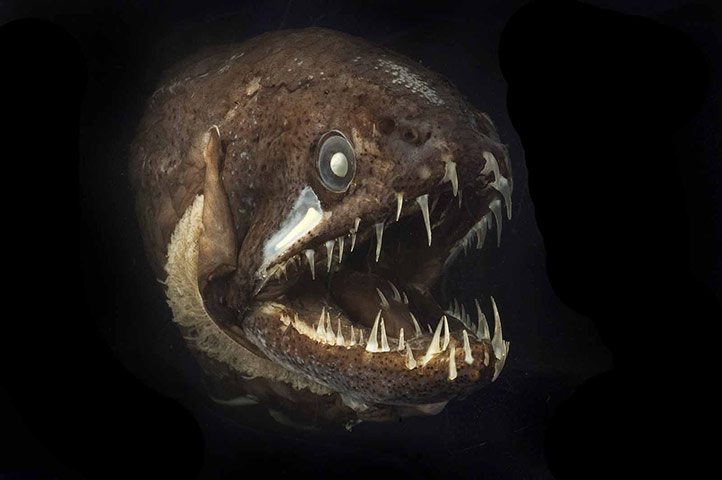
Enlarge that picture. Now, you'll notice a very peculiar thing: it has teeth on its tongue. TEETH! ON ITS TONGUE! That is too amazing. It's a dragonfish from Australia, though I couldn't find much other information about it. It lives in deep water, and you do not want to get bitten by it. Obviously. It was discovered by the Census of Marine Life, which is one of the most exciting projects I've ever heard of. For more information, check out The Guardian.

Wednesday, December 29, 2010

An Introduction to Treehoppers

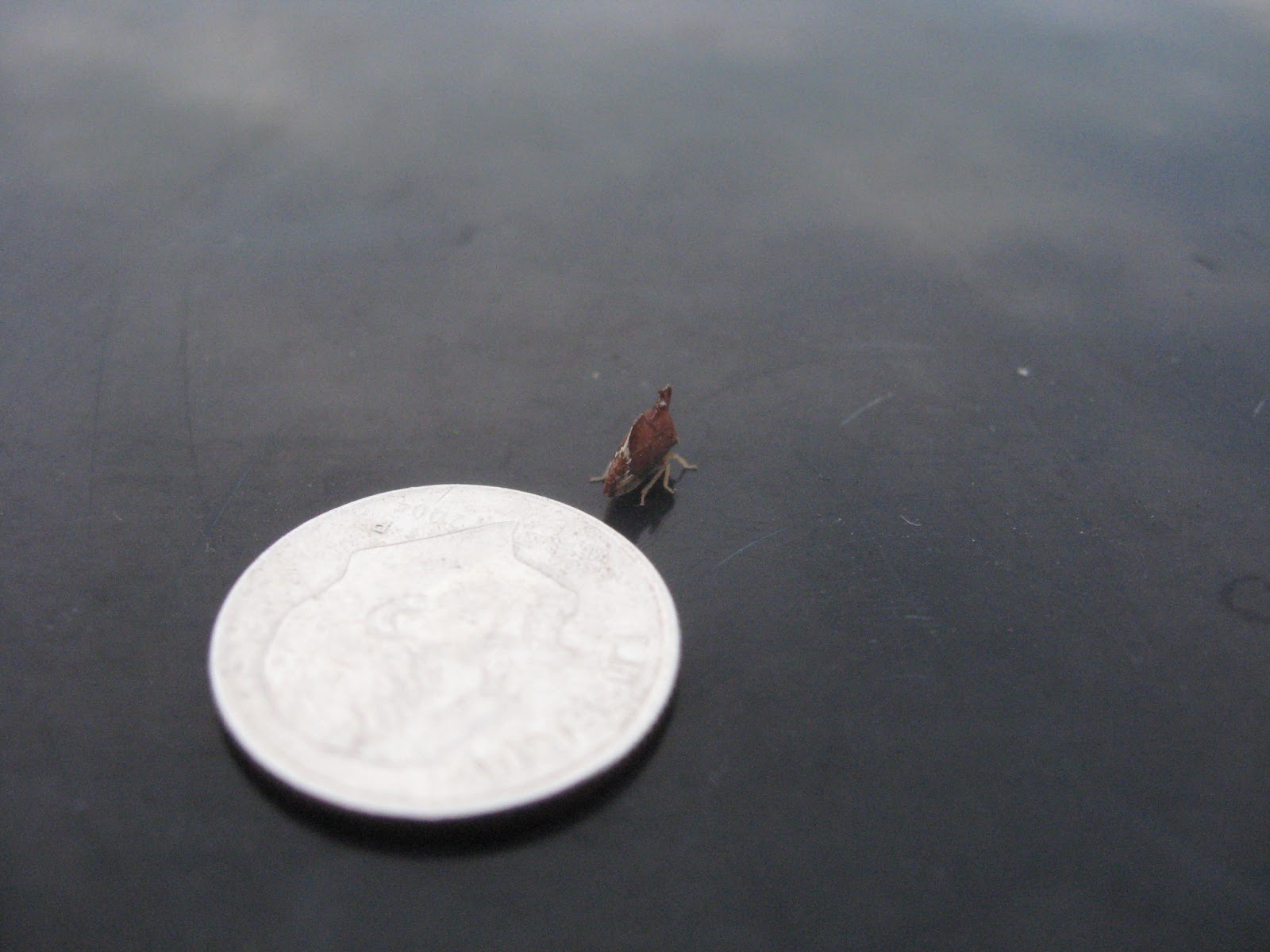
Treehoppers are marvelous little creatures from the family Membracidae. They're in the same suborder as the cicadas (Auchenorrhyncha), and were formerly classified in the order Homoptera. Treehoppers can be pretty tiny, only millimeters in length. The one in the picture below has a dime for scale. They're quite interesting creatures, and can vary a lot in their shape, often sporting horns and structures that allow for nice mimicry. 

 Entylia carinata, a common species in Ohio

This particular species, Entylia carinata, formerly had the species name of bactriana, after the Bactrian camel, which has two humps. The similarities are striking.

 The moniker carinata means shell-shaped.

Fun fact: the guy on the left is the man who named the species as carinata, Johann Reinhold Forster. Painting by John Francis Rigaud, 1780. Image credit to Wikipedia.

 Notice how its body is shaped to mimic a leaf, right down to the notch near its head.

For some more information about treehoppers, check out the following links:
General Treehopper Information
Pictures & Life Cycle Information
Short Tidbit of Information
Marvelous Array of Pictures, Courtesy of Bugguide.net

Monday, December 27, 2010

It's Hard to be a Hornworm


In Ohio, there's a delightfully gregarious caterpillar known as Manduca sexta, or the tobacco hornworm. It's placed within the Sphingidae family, which is composed of the hawk moths. Take a look at the Wikipedia page for the hawk moths: they're all spectacular. Some of the adult moths resemble birds or bees, they're just amazing. To get back on topic, the tobacco hornworm feeds on tobacco (obviously), as well as other plants within the family Solanaceae, which includes tomatoes. This makes them pests to gardeners, which is pretty unfair. Tobacco hornworms develop into some beautiful moths and are quite large, so they're truly a sight to see once they reach maturity. Luckily for me, they also feed on Datura wrightii, a plant within the same family as tobacco and tomato, which grows near my house.

I had the fortune of finding a few of the caterpillars on the Datura plant, so I plucked them along with some leaves and placed them in a container in my room. They were still in their early instars (An instar is simply a stage in the life of a caterpillar. As it grows, it will molt and enter a different instar, gradually getting bigger as it enters each successive instar.) and so were relatively small, as you can see from the pictures. Of course, they did not stay small for long. I ended up plucking five or more leaves each day for each caterpillar in order to give them enough food, and I still wasn't sure if that amount was enough. They would eat through all the leaves in short order, and sometimes I found myself getting even more leaves for them throughout the day.


And so, they each progressed through their instars, growing larger and larger. I was surprised at just how big they were getting: these aren't small, inch-long creatures. If you're creeped out by large worms or snakes, then you won't like these guys (but you should anyway). Taking a look at the pictures now, you can start to notice their stripes and small eye-like spots on their sides. The stripes are one way to distinguish them from a similar species, the tomato hornworm, which also feeds on tomatoes. It has eight V-shaped markings, while the tobacco hornworm has the seven diagonal stripes*. The stripes serve another purpose as well: camouflage. The stripes break up the hornworm's pattern while it's feeding on leaves, helping it to blend in with the overall shape and color of the plant. If you encounter a plant with skeletonized leaves, it's a good indication that a caterpillar has been feeding on the plant, but even if the caterpillar is still on the plant while you're looking at it, it's no guarantee that you'll find it. They're remarkably hard to find, even when you know they're there (which is remarkably frustrating).

Now, the orange eye-like spots on the hornworm's side are its spiracles. Spiracles are how insects breathe, simply put. It probably doesn't hurt the insect's chances of survival that its spiracles look like eyes, either.

In the picture below, one of the caterpillars has undergone ecdysis (molting), and has entered its next instar. Tobacco hornworms usually have five instar stages, but can have more depending on growth conditions. Near the caterpillar's posterior end, you can see the remains of its previous molt. The caterpillar proceeded to eat these remains. When a kid is growing and needs nutrients, they're forced to eat vegetables. When you're a caterpillar, you eat what used to be your skin. Except for the head case. That part is too hard, so it just pops off and is left alone.

Pictured: a delicious gourmet meal

You can tell that the caterpillars have grown much larger than they used to be. The most mind-blowing fact about it is that these pictures were all taken over the course of about a week. Caterpillars can grow pretty quickly.

  Caterpillar excrement is known as "frass." It fertilizes plants and all that good stuff. Also, you can hear it falling down the leaves of trees and other plants like rain sometimes.

 The small reddish brown object is the pupa of another caterpillar, Ceratomia catalpae.

Still eating.

At a certain point during the hornworm's fifth instar, it starts undergoing physiological changes signaling its body that it's time to pupate. Different hormones start being produced, and the hornworm's behavior changes. Effectively, it's puberty, but with less pimples. One of the behavioral changes is quite pronounced, and results in the caterpillar entering a so-called "wandering stage." The caterpillar descends from its plant and starts walking around on the ground, looking for a good place to burrow into the dirt. Or, if the caterpillar is in an insect cage, it will walk around the enclosure and stomp on everything. (Various sources recommended that I remove excess frass to avoid a messy situation. It was a very helpful recommendation, and saved me a lot of cleanup time later on. If you decide to raise a hornworm, you would do well to heed the same advice.) After a little while of wandering and being much more active than it was during its feeding stages, the hornworm will start to dig into the soil. It's a fascinating process: the hornworm uses its body as a shovel. It doesn't so much as dig a burrow as pulverizes its way down into the dirt and decides "Yep, this'll do." I found I had new respect for my hornworm after watching it go underground.

 Lateral view, the hornworm at work. 

The problem with not having quite enough dirt in the insect cage.

A fascinating visual cue that the hornworm has entered its wandering stage is the presence of its aorta (its heart). On the "back" of the hornworm (its dorsal side, for those of you anatomically inclined), the hornworm's aorta pumps its blood (technically hemolymph, I do believe), which is quite conspicuous. 

The hornworm's aorta, hard at work.

After the wandering and digging, the hornworm settles in for some huge changes to its anatomy and physiology. 
Also notice how the posterior end of the hornworm looks a bit like a face. Some mimicry, perhaps.

While that hornworm is busy pupating, let us catch up with the other hornworm.

.....or not.

And now it is time to learn about one of the most interesting natural phenomena in the animal kingdom: Parasitoidism. You may know about parasites: nematodes, flatworms, and according to some, politicians (we won't get into that argument here). Parasitoids are similar to parasites in that they also live inside of a host and feed from it. However, parasitoids take parasitism one step further. Parasites live and feed off of a host, yes, but they do it in a way that doesn't kill the host. If the host dies, the parasite also dies since it loses its food supply. Parasitoids, on the other hand, have little concern for the well-being of the host. In a parasitoid-host relationship, the parasitoid feeds off the host in such a way that the host dies. The parasitoid has special adaptations that allow it to survive after the death of the host, so to the parasitoid, the final result for the host doesn't matter.

So what does that mean in the context of Manduca sexta
Manduca sexta has the misfortune of being prey for some species of wasps in the family Braconidae, which contains a variety of parasitoid wasps. These wasps seek out various caterpillars, and when they find them, they lay their eggs inside of the caterpillar. This is bad news for the caterpillar, as its defensive options are limited. The plants it feeds on contain toxic chemicals, and there is evidence that some caterpillars can ingest more leaves containing these chemicals to self-medicate against parasitoid infection**, though such a study has not been researched specifically for Manduca sexta. However, it is not too much of a leap to hypothesize that the hornworms could make use of toxic chemicals in an attempt to kill the parasitoids. 

As a side note, such parasitoidism is obviously beneficial for the host plant of the caterpillar, as it can suffer severe skeletonization of its leaves due to the caterpillar's voracious appetite. The plant is not entirely defenseless, however, and is able to release chemicals to attract such parasitoids to rid itself of the caterpillars. To learn more, check out this wonderful article from Scientific American

So, the hornworm has had the misfortune of being parasitized. What can it look forward to? Aside from the hope that the eggs won't hatch, not much. Its future is pretty bleak. First, the eggs will hatch. The wasp larvae will start eating the insides of the caterpillar. Since they are parasitoids, not parasites, they won't have much respect for the normal, healthy functioning of the various organs and systems of the caterpillar. The little respect for the caterpillar's health that the wasp larvae will have will simply be not eating the vital organs first, allowing the caterpillar to live so that the larvae will have a safe place to develop. Once they have grown sufficiently, the larvae move on to phase two. 

The larvae eat their way through the caterpillar's skin. If you go back to the picture of the larvae coming out of the hornworm, you will notice a few dark circles on the caterpillar. Those are wasp larvae eating their way out, almost breaking through the skin. Once the larvae have made it out of the caterpillar, they will immediately start spinning cocoons. They will stay in the cocoons for about a week or two, and then emerge as adults. During all this time, the caterpillar is still alive. Depending on nature's mercy, the caterpillar may die soon after the wasp larvae have burst from its body, or it may stay alive until the adult wasps emerge from their cocoons, and even for a few days after. I imagine the caterpillar curses its existence if it is in that predicament.

 Adult braconid wasps emerging from their cocoons.
The cocoons look like small white egg sacks. There can be as many as 50 or more on one caterpillar, depending on its size and unluckiness. 

 These adult wasps will each seek out other caterpillar targets.

The resulting caterpillar. 

  
For an even more gruesome lesson on parasitoidism, National Geographic has you covered.

Now, time to move on to a healthy hornworm. 

Pupal stage.

The caterpillar has undergone quite a change while underground, resulting in its pupal stage (also known as Metapod, to Pokémon fans). The most outstanding feature is the curved tube at its anterior end, which its tongue grows in. The pupa is not entirely defenseless. When touched, it will jerk its posterior end violently, which is quite startling if you do not expect it (I speak here from personal experience). The pupal stage also takes place while buried a few inches underground, which isolates it from many predators.

As the moth gets closer to eclosion (emergence from the pupal stage), the pupa will get darker and more translucent.
It will turn almost purple in some areas.

Finally, the moth will emerge from the pupa. I assume the orange-brown liquid to be hemolymph, though I haven't found a source identifying it for sure.

The pupal stage lasted a little over two weeks, and the final result was...


It's quite a beautiful moth, very "furry." It's also quite large, to the degree of a small bird. Knowing the size of its caterpillar and pupa, it's no surprise.

 Check out those eyes! Also notice the tongue curled up into a ball. The adult feeds on nectar.


 A full view of the body and wings. Notice the series of orange spots on its abdomen, absolutely stunning. There are six on each side, twelve in all. I assume these are what the sexta (Latin for six) in the species name refers to.

View of the closed wings. The newly emerged moth cannot fly, but must first pump hemolymph into its wings.

 Ventral view, with ruler for scale.

 It has quite the wingspan.

 Truly, it's a beautiful moth. It's a shame they're seen as pests.

This particular specimen is now located in the collections at Marietta College.

For more information about Manduca sexta, check out the following websites:


References:

Friday, December 24, 2010

Capstone Shenanigans

Back at the start of November, I had the pleasure of accompanying my good friends Ryan and Will to the site of Ryan's capstone project in Lowell. He was looking at a layer of rocks in an outcrop there, and had invited me to come along since he had seen a lot of insects buzzing around during his earlier trips to the outcrop. That was pretty much all the information I needed, so I tagged along to see what all was there, as well as to make sure that Ryan didn't die in a rock slide.

Since it was early November by the time we made it out to the outcrop all together, it was a bit chilly and there weren't a huge amount of insects like there had been in September. Not to say there wasn't still a lot of neat things to see, I just didn't end up finding any huge grasshoppers. The first things I came upon were bagworm cases on some branches. Bagworms are in the family Psychidae, and the larvae build cases out of whatever detritus they find around them. It's all held together by silk on the inside, and the end result is the bags you see hanging from tree branches. Wikipedia and Penn State University have some more information on them if you're so inclined.

This particular bagworm seems to have fallen on hard times. 
Birds sometimes tear their bags open, and they also have other insect predators.

This one was in better shape. 
I have it in an insect cage currently, and am waiting to see if the bagworm will emerge.

I also found some neat lichen species on the trees in the area. Lichens are assemblages of a fungus and an alga or cyanobacteria. The alga or cyanobacteria performs photosynthesis, providing the lichen with energy, and the fungus retains water, can obtain minerals from the substrate, and protects the photosymbiont. Lichens are slow growing, which makes them great organisms to study in order to measure air quality, because they retain heavy metals from the air for a long time. To really get a good idea of how cool lichens really are, I suggest the book Lichens by William Purvis. Seriously, it's a great read.

You can see the fruiting bodies of the lichen (apothecia), the blackish discs.
Lichens are reputed to have "remarkable" sex lives.
I also found a  small grasshopper. Not sure of the family.


In order to get up to the outcrop, we had to climb up an access road and a hill. We parked the car at the bottom (it was easier than driving up, considering the condition of the road) and started walking. (Remember that we parked the car and it was out of our sight for about an hour and a half, it will be important to the story later.) So far, all the pictures I've posted have been from trees and other things we saw as we walked up to get to the outcrop. Most of the fall foliage had started to fall off the trees, so it was a bit grim, we were met with mostly gray and brown. At one point, I found a marvelous yellow butterfly, and with Will's help, caught it in my net. Unfortunately, during the transfer to a holding container (an old spice container), it got away. Tricky little things they are. So, our one dash of color disappeared as soon as it had arrived. But onward we trekked.

Led on by our fearless guide Ryan, we arrived at the top to be greeted by...

Tell me this isn't cheery.


 This has a bit more cheer. Rhus glabra, Smooth Sumac. 
The berries are used as winter food by wildlife.

Will and I exchanged a knowing glance. "Yeah, this is awesome!" We made our way through the brush and had two paths in front of us. We could either walk through the middle, where more plants (mostly invasive Japanese honeysuckle and multiflora rose) grew between the rocks, or we could walk on the slope of dirt and rock. Neither route was the greatest, but we decided to walk on the slope, since that was where Ryan needed to go. He explained to us what exactly he was doing, but most of it either went over my head or I've forgotten it now. At any rate, he seemed to know what he was doing, and it was interesting to see his process.

Of course, I ended up getting sidetracked on the way there because I kept looking around and finding new things.

 I believe this little guy is a field cricket, subfamily Gryllinae.

 Daucus carota, a biennial plant from which the carrot was cultivated.
Commonly called Queen Anne's Lace.

 This is what the seeds look like. 
They stick to things like clothing and fur, and the top of the plant will break off and roll around like a tumbleweed.

A milkweed pod, genus Asclepias. The follicle opens and the seeds are dispersed by the wind.

I made my way into the middle of the small...valley I suppose you could call it, and took a look around. It was tough to make my way through it with all the rocks and underbrush: I couldn't be completely sure I had much footing when I planted my feet somewhere new, and I also didn't know what might be lurking around. Lately I've had a nasty habit of finding venomous snakes, so that was in the back of my mind. At any rate, none were found that day. What was found was A LOT of Japanese honeysuckle (Lonicera japnoica), multiflora rose (Rosa multiflora), and a good amount of milkweed plants. The honeysuckle and multiflora rose are both invasive species in Ohio, so it was unfortunate to see so much of it here. Birds eat the berries, and in turn disperse the seeds, so both are pretty tough to extirpate. The milkweed, on the other hand, is fine. It's quite pretty when it flowers, actually, and is a host plant to a multitude of insects, including butterflies. 

 Invasion of the plants! Notice the Japanese honeysuckle twining up other plants, pretty neat.

Inside the seed follicle, the seeds are tightly packed.

 A mass of large milkweed bugs, Oncopeltus fasciatus, were gathered around this milkweed follicle.

 This particular one attempted to beat a hasty retreat when I tried to take a picture. 
They can move pretty quickly when they want to.

Now during all this time that I was enjoying myself and being overjoyed at all the neat things I was finding, Ryan was chipping away at his rocks and preparing to make a splash in the world of Geology. Or something. He had a rock hammer and I heard him using it, so I assume that's what he was doing. I have no evidence to prove otherwise. Will, on the other hand, was contenting himself with reading in the wilderness. A good choice.

I believe he's making his way through the last Harry Potter book.
We saw the midnight showing of the movie when it came out in theaters a week or so later.

Next I made my way up the other side of the "valley." The last time I had climbed up a slope much was in New Mexico. This time there were less cacti, for which I was very thankful. Especially since I slipped a few times and had to reach out blindly and grab to make sure I didn't fall completely. I made my way to the top and was greeted by a pleasant surprise of color. Even so late in the fall, some flowers were still in bloom.


New England Aster - Symphyotrichum novae-angliae

Beautiful! 

 On that particular day, the temperature was hovering around the mid-40s to low-50s, one of the reasons for the lack of insects. An interesting side effect to the chilly temperatures was that the insects that were out and about were a big lethargic. Mostly, this pertained to the bumblebees I came across. When insects get cold, they move slower, which means you can chill an insect in a refrigerator or freezer to get it to stay still for longer. Very useful for taking pictures of them. I ended up finding a few bees which didn't move much, making me think at first that they might be dead. Upon closer inspection however, I found out that they were indeed alive, they just couldn't really fly. 


Common eastern bumblebee - Bombus impatiens

This bee in particular was chilling out on a flower. I took it upon myself to touch it to see what would happen, but instead of flying off, it simply lifted its leg, as if to say "Hey! Stop it. Leave me alone man." It was too cold for the bee to fly, so that's all it could do! Luckily for the bee, I'm a nice guy, so I left it alone after taking a few more pictures.

At the top of the hill was a small field, so I walked around and explored it for a while. I found a lot of lichen on some rocks, some oak trees, more milkweed, and some felled trees and logs. I looked out over the field and a small sphere about the shape of a ping pong ball caught my attention. 


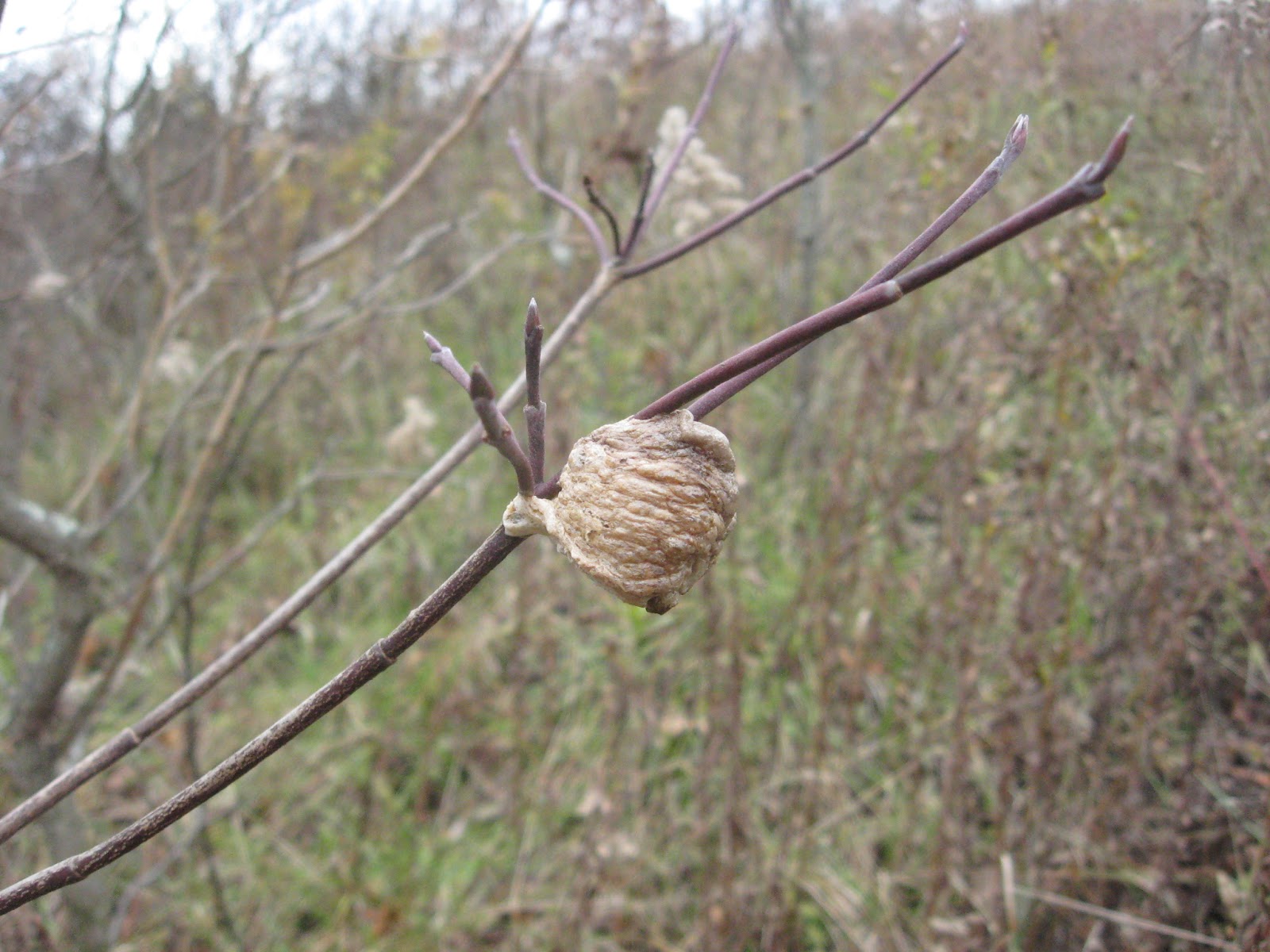
I had been keeping a few praying mantids (Chinese mantids to be specific) in my room and in the College's science building, so I knew exactly what I was looking at: a mantis egg sac. The mantis deposits its eggs and covers them in a foam-like substance, resulting in what you see above. The sac protects the eggs inside from the elements, and once Spring comes around, the eggs hatch, resulting in a mass of about 100 little praying mantids. It's fascinating stuff. I clipped this twig and took the egg sac back with me, and it actually hatched about a month later, resulting in this:

 I had to remove the container from my room the day after the mantids hatched, due to the complaints of my fellow dorm dwellers.

Time was running out while I was in the field, so I had to make the most of the time I had remaining. I headed over to the felled trees, finding lichens and mushrooms growing around and on the decaying wood. I tore off a few layers of the bark, and found a neat little ecosystem within the decaying wood. I found some small beetles, and a few beetle grubs inside, feeding on the wood and whatever else was there. 

Larva of a fire colored beetle, in the family Pyrochroidae


Unfortunately, I was out of time after finding the beetle grubs and had to head back. I met up with Will and Ryan again, and we made our way out of the outcrop.

 
 Another bumblebee, which did not appreciate being touched.

 Teasel, genus Dipsacus. Not the best thing to grab onto, but a decent comb.

 Finishing up

  Now, remember back to when I told you that we left our car parked near the base of the road and out of our sight. We forgot to turn off the headlights, so the battery died and we had to wait about a half hour for a friend to come help us jump start the car. That was a bit embarrassing and not the best end to our adventure, but it could have been worse!