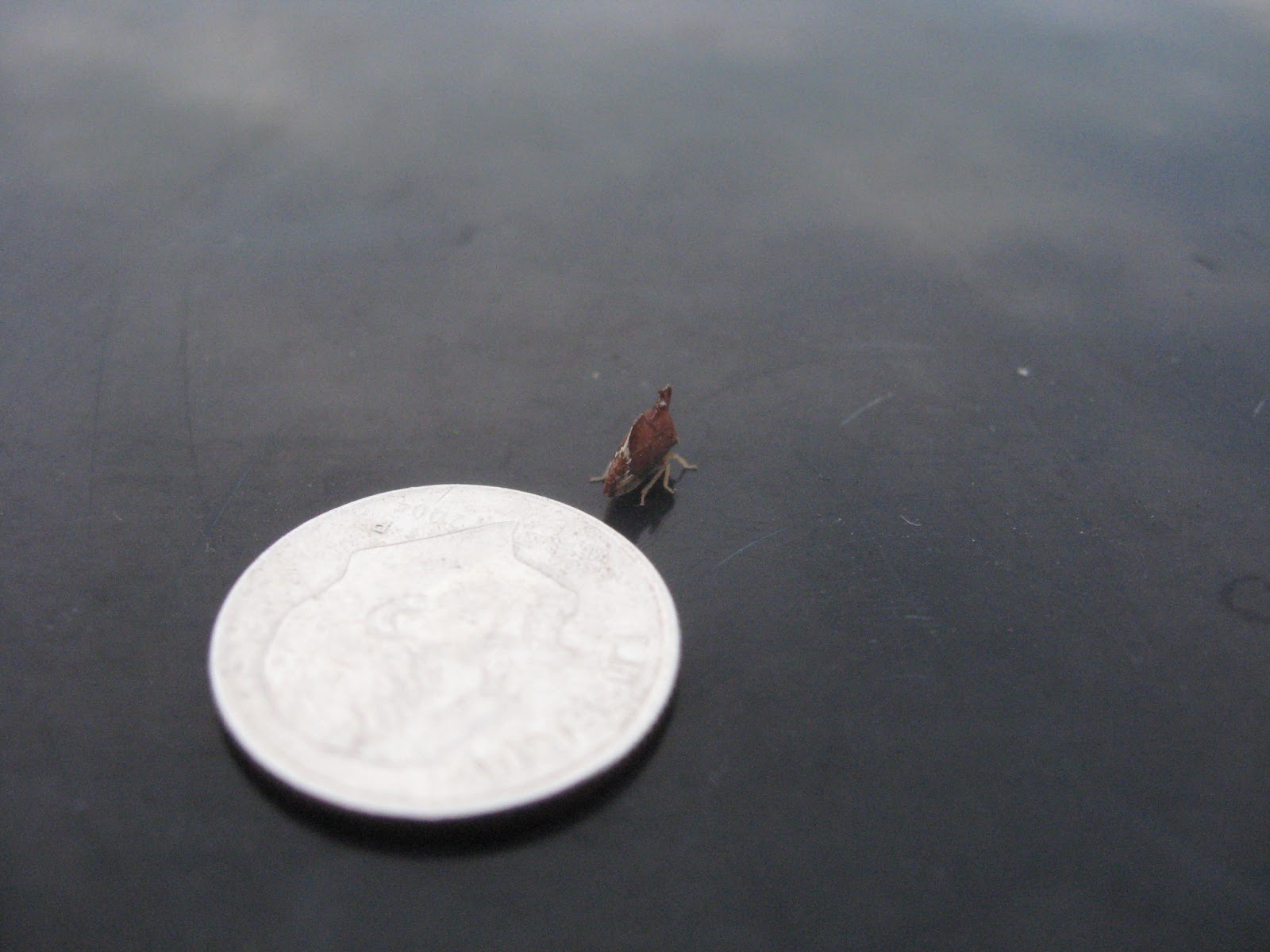
This past summer, as I mentioned a few times before on this blog, I had the opportunity to carry out a field survey for assassin bugs at the Barbara A. Beiser Field Station. This field station is used by the biology classes at Marietta College for lab sections, such as Zoology and Aquatic Biology.
I knew that I would have a good portion of free time during the summer, and I wanted to get a head start on my capstone project, and do some more research with insects. Out of that grew a project during which I would research the abundance, diversity, and ecology of
assassin bugs (insects in the family Reduviidae). I wrote up an application for an Investigate Studies Grant for these types of student-led projects from the college, and I received one to carry it out.
It took place during six weeks in May and June, and I found a lot of different species--both assassin bugs and other insects. I focused on the assassin bugs most of the time, and presented on my findings (I'll elaborate on that in another blog post, but I found 7 different species of assassin bugs) in October. Since then, I've been focusing on all the other insects I found during the project. In order to save time and keep focused, I didn't collect every insect I found, but I did try to snap some pictures whenever I found something I hadn't seen before.
Like this, for example. A scarab beetle, the Emerald Euphoria - Euphoria fulgida.
Fast forward to this past week, and I've been focusing on identifying all the insects and other arthropods I saw. Assisting me with that has been
Project Noah, an amazing website that anyone can submit their pictures of wildlife to, upload them to a map, and essentially crowdsource nature with others. (It will receive its own blog post in the future.) I just finished uploading all my pictures from my Investigative Studies Grant project, which gave me a lot of time to reflect on everything I encountered.
It also gave me a number: 137 separate species of insects, plants, spiders, fungi, slime molds, and miscellaneous other groups of life just from those 6 weeks.
That's not too shabby, if I do say so myself. Since it's the time of year to write reflections, I figured that now is as good a time as any to briefly highlight some of my favorite photographs and organisms I encountered. I'll limit myself to five to keep the length of this post reasonable.
This was the first insect I encountered--right on the gate leading to the field station. Unbeknownst to me at the time, I would be seeing A LOT of soldier beetles (family Cantharidae). This particular one is Podabrus tomentosus, which I didn't see many of in the interior of the forest. You know what I did see a lot of? Firefly mimics. Firefly mimics EVERYWHERE. It wasn't even until I was reviewing my photos that I even figured out that most of what I thought were fireflies were actually soldier beetles in disguise. That being said, that is some amazing mimicry. (Consider that paragraph a cliff hanger, I'll cover these mimics in another post.)
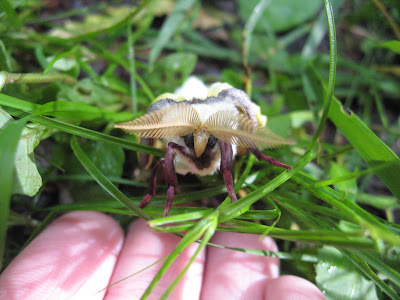
Serendipity is better than skill! I got lucky on my first day at the field station and stumbled upon (literally, I almost stepped on it!) a
luna moth (
Actias luna) that had just emerged from its pupal stage and was crawling along in the grass. Adult luna moths only live for a week and do not only: they only live to reproduce. I had never encountered a luna moth before, so I was excited out of my mind when I found this male (notice how large the antennae are, that's how you can tell the difference between males and females). Not wanting to step on him, I picked him up and placed him on a tree so that he could pump up his wings in peace. I returned every so often over the course of three hours to watch and it was just a beautiful sight. It's a real privilege that we have such a majestic moth in Ohio.

This is the
Orange-patched Smoky Moth (
Pyromorpha dimidiata), a rare case in which the common name describes the organism extremely well. At first glance you might be reminded of a net-winged beetle in the family Lycidae. It's suspected that this moth is a mimic of those beetles (check out the genus
Calopteron for comparison), but may also have its own chemical defenses. Due to this, the mimicry exhibited by this moth and the net-winged beetle is characterized as Müllerian mimicry.
Since both species are toxic and have similar aposematic (fancy word for bright warning color) patterns, the mimicry works to the advantage of both organisms: predators leave them alone since they're distasteful. This is opposed to Batesian mimicry, in which a model toxic species is imitated by other non-toxic species, which obtain the same benefits without needing to be toxic themselves. It's the insect equivalent of putting your purchase on someone else's tab. For more information about this species, you can check out Ted Macrae's entry at
Beetles in the Bush.
Next up is a beautiful firefly I found crawling on a decaying log.
Or is it?
Fireflies must be awesome beetles to mimic: even the click beetles (family Elateridae) are getting in on the action! Here we have
Denticollis denticornis. Sorry, no common name here, but for simplicity we can refer to it as the firefly mimic click beetle. I mistook it for a firefly when I first saw it, but upon closer inspection, the flared pronotum that fails to cover the head gives it away as a click beetle. Simply a beautiful specimen, I wish I had taken the time to get some more pictures and see where it was going. Now, which mimicry would this click beetle be exhibiting: Müllerian or Batesian? For a nice discussion about mimicry's benefit to this species, check out
this link to BugGuide.
Finally, we come to one of my favorite beetles: the pleasing fungus beetle
Megalodacne heros. It's in the family Erotylidae and looks as if it should be coming out around Halloween. Unfortunately, this beetle is on the wrong calendar and is restricted to the summer months.
As you can guess from the common name, the beetle feeds on fungus. In this case, I found it chewing on some bracket fungus as night was falling. It's a large beetle (two centimeters long) and its elytra are quite smooth. After I captured it and took it back to the lab, I was watching it move around under the microscope. As I watched it move its leg (it had flipped itself on its back), I was awed by how smooth its movements were.
Truthfully, this beetle showed me how beautiful insects could be, just by something as simple as their movement. It was a "Eureka!" moment for me, and has ensured that this beetle will stay at the top of my list of favorite insects.
Too often we recoil at insects and other small arthropods because they look ugly or creep us out. Casting them down in judgement is ignorant and quite offensive to how elegantly they go about their lives, however. Not until you take the time to immerse yourself in their world (that is, what life is like for organisms that are measured in inches at most) can you truly appreciate the beauty and real magic that nature exhibits.
If you're interested in seeing more of my photographs from the Beiser Field Station, you can find my collection on my userpage at Project Noah.