Showing posts with label lichen. Show all posts
Showing posts with label lichen. Show all posts
Friday, November 2, 2012
Science Video Friday - I Lichen This Post
The wonderful Field Museum in Chicago featured this video about Steve Leavitt and his lichen research, which hit my soft spot for these organisms.


Wednesday, October 31, 2012
The Top of the Gob Pile
I was inspecting an area with an acid mine drainage problem last Wednesday for work and we found the source pretty easily: a massive gob pile. What's a gob pile? It's the pile of stuff left over from coal mining. There's a lot of different materials in it, including a lot of shale, giving it a black color. It's an ugly thing that causes lots of problems, but regulation in the US has stopped companies from abandoning them since 1977.
Interestingly enough, there were a few plants growing on the top of the pile, and a few old stumps, which held some biology after all.

This tiny grasshopper blended in with the fall colors, until it jumped onto a patch of moss.

Pixie Cup Lichen, Cladonia pyxidata, grew in a couple patches.

British Soldier Lichen, Cladonia cristatella, made itself known with its bright red caps. Those red caps on the stalks hold its spores.

Interestingly enough, there were a few plants growing on the top of the pile, and a few old stumps, which held some biology after all.

This tiny grasshopper blended in with the fall colors, until it jumped onto a patch of moss.

Pixie Cup Lichen, Cladonia pyxidata, grew in a couple patches.

British Soldier Lichen, Cladonia cristatella, made itself known with its bright red caps. Those red caps on the stalks hold its spores.

And since I can never resist turning over a decaying log, I was rewarded with this scarab beetle grub. Not sure what it is, but it's kind of pretty. If you squint a lot, it almost resembles a delicious dumpling.
"Life will find a way."
Monday, January 24, 2011
Líquenes de Costa Rica
I had the great fortune of going to the Poás Volcano this weekend and seeing all the interesting biota there. The first thing I noticed after stepping off the bus on starting the walk up to the crater was the intense smell of sulfur. It was almost suffocating and apparently some people got a bit sick from it. Of course, what else can you expect from a volcano?

The volcano is located within Poás Volcano National Park, so naturally there was a gift shop. It had a wonderful selection of books that were 50% off, and I found one about lichens! This was a pretty big deal to me, since it's difficult enough to find books about lichens in the United States, so I promptly bought it. It's Líquenes de Costa Rica, by Loengrin Umaña and Harrie Sipman, and is published by INBio, the Instituto Nacional de Biodiversidad, a huge Biodiversity institute in Costa Rica. The book has some general information about lichens, and identification information for 55 species of Costa Rican lichens.
It's always nice to find some extra information about lichens since they are generally overlooked. It's amazing to think that a lichen is a symbiosis between a fungus and an algae; it looks radically different from either of those. They're grouped in the Kingdom fungi, and are referred to as lichenized fungi, showing the limits of our taxonomic systems.

Lichens are useful as biomonitoring agents. They're slow-growing and are apt to acquire minerals and things from the air. They hold onto these materials for a long time, and so can be used to monitor air pollution levels in an area. This particular characteristic is something important for at least two studies going on in Marietta, Ohio, measuring manganese levels and air quality. In the above picture, the lichen doesn't look terribly healthy, and this is probably due to the sulfur levels in the area.

Another example of air quality and lichen biomonitoring can be found in the area near Kayford Mountain, West Virginia, where a mountaintop removal mining site's air pollution can be seen in the lichens.

The main crater, which is 950 feet deep.
The volcano is located within Poás Volcano National Park, so naturally there was a gift shop. It had a wonderful selection of books that were 50% off, and I found one about lichens! This was a pretty big deal to me, since it's difficult enough to find books about lichens in the United States, so I promptly bought it. It's Líquenes de Costa Rica, by Loengrin Umaña and Harrie Sipman, and is published by INBio, the Instituto Nacional de Biodiversidad, a huge Biodiversity institute in Costa Rica. The book has some general information about lichens, and identification information for 55 species of Costa Rican lichens.
It's always nice to find some extra information about lichens since they are generally overlooked. It's amazing to think that a lichen is a symbiosis between a fungus and an algae; it looks radically different from either of those. They're grouped in the Kingdom fungi, and are referred to as lichenized fungi, showing the limits of our taxonomic systems.

Lichens are useful as biomonitoring agents. They're slow-growing and are apt to acquire minerals and things from the air. They hold onto these materials for a long time, and so can be used to monitor air pollution levels in an area. This particular characteristic is something important for at least two studies going on in Marietta, Ohio, measuring manganese levels and air quality. In the above picture, the lichen doesn't look terribly healthy, and this is probably due to the sulfur levels in the area.

Kayford Mountain lichen, notice the discoloration near the top.
Another example of air quality and lichen biomonitoring can be found in the area near Kayford Mountain, West Virginia, where a mountaintop removal mining site's air pollution can be seen in the lichens.
Lichens are pretty useful, and a lot more interesting than they get credit for. Hopefully I'll find some more information about them while I'm down here. I might even learn something I can take back to Ohio and use.
Friday, December 24, 2010
Capstone Shenanigans
Back at the start of November, I had the pleasure of accompanying my good friends Ryan and Will to the site of Ryan's capstone project in Lowell. He was looking at a layer of rocks in an outcrop there, and had invited me to come along since he had seen a lot of insects buzzing around during his earlier trips to the outcrop. That was pretty much all the information I needed, so I tagged along to see what all was there, as well as to make sure that Ryan didn't die in a rock slide.
Since it was early November by the time we made it out to the outcrop all together, it was a bit chilly and there weren't a huge amount of insects like there had been in September. Not to say there wasn't still a lot of neat things to see, I just didn't end up finding any huge grasshoppers. The first things I came upon were bagworm cases on some branches. Bagworms are in the family Psychidae, and the larvae build cases out of whatever detritus they find around them. It's all held together by silk on the inside, and the end result is the bags you see hanging from tree branches. Wikipedia and Penn State University have some more information on them if you're so inclined.


This bee in particular was chilling out on a flower. I took it upon myself to touch it to see what would happen, but instead of flying off, it simply lifted its leg, as if to say "Hey! Stop it. Leave me alone man." It was too cold for the bee to fly, so that's all it could do! Luckily for the bee, I'm a nice guy, so I left it alone after taking a few more pictures.


Unfortunately, I was out of time after finding the beetle grubs and had to head back. I met up with Will and Ryan again, and we made our way out of the outcrop.


Since it was early November by the time we made it out to the outcrop all together, it was a bit chilly and there weren't a huge amount of insects like there had been in September. Not to say there wasn't still a lot of neat things to see, I just didn't end up finding any huge grasshoppers. The first things I came upon were bagworm cases on some branches. Bagworms are in the family Psychidae, and the larvae build cases out of whatever detritus they find around them. It's all held together by silk on the inside, and the end result is the bags you see hanging from tree branches. Wikipedia and Penn State University have some more information on them if you're so inclined.

This particular bagworm seems to have fallen on hard times.
Birds sometimes tear their bags open, and they also have other insect predators.

This one was in better shape.
I have it in an insect cage currently, and am waiting to see if the bagworm will emerge.
I also found some neat lichen species on the trees in the area. Lichens are assemblages of a fungus and an alga or cyanobacteria. The alga or cyanobacteria performs photosynthesis, providing the lichen with energy, and the fungus retains water, can obtain minerals from the substrate, and protects the photosymbiont. Lichens are slow growing, which makes them great organisms to study in order to measure air quality, because they retain heavy metals from the air for a long time. To really get a good idea of how cool lichens really are, I suggest the book Lichens by William Purvis. Seriously, it's a great read.

You can see the fruiting bodies of the lichen (apothecia), the blackish discs.
Lichens are reputed to have "remarkable" sex lives.

I also found a small grasshopper. Not sure of the family.
In order to get up to the outcrop, we had to climb up an access road and a hill. We parked the car at the bottom (it was easier than driving up, considering the condition of the road) and started walking. (Remember that we parked the car and it was out of our sight for about an hour and a half, it will be important to the story later.) So far, all the pictures I've posted have been from trees and other things we saw as we walked up to get to the outcrop. Most of the fall foliage had started to fall off the trees, so it was a bit grim, we were met with mostly gray and brown. At one point, I found a marvelous yellow butterfly, and with Will's help, caught it in my net. Unfortunately, during the transfer to a holding container (an old spice container), it got away. Tricky little things they are. So, our one dash of color disappeared as soon as it had arrived. But onward we trekked.
Led on by our fearless guide Ryan, we arrived at the top to be greeted by...

Tell me this isn't cheery.

This has a bit more cheer. Rhus glabra, Smooth Sumac.
The berries are used as winter food by wildlife.
Will and I exchanged a knowing glance. "Yeah, this is awesome!" We made our way through the brush and had two paths in front of us. We could either walk through the middle, where more plants (mostly invasive Japanese honeysuckle and multiflora rose) grew between the rocks, or we could walk on the slope of dirt and rock. Neither route was the greatest, but we decided to walk on the slope, since that was where Ryan needed to go. He explained to us what exactly he was doing, but most of it either went over my head or I've forgotten it now. At any rate, he seemed to know what he was doing, and it was interesting to see his process.
Of course, I ended up getting sidetracked on the way there because I kept looking around and finding new things.

I believe this little guy is a field cricket, subfamily Gryllinae.

Daucus carota, a biennial plant from which the carrot was cultivated.
Commonly called Queen Anne's Lace.

This is what the seeds look like.
They stick to things like clothing and fur, and the top of the plant will break off and roll around like a tumbleweed.

A milkweed pod, genus Asclepias. The follicle opens and the seeds are dispersed by the wind.
I made my way into the middle of the small...valley I suppose you could call it, and took a look around. It was tough to make my way through it with all the rocks and underbrush: I couldn't be completely sure I had much footing when I planted my feet somewhere new, and I also didn't know what might be lurking around. Lately I've had a nasty habit of finding venomous snakes, so that was in the back of my mind. At any rate, none were found that day. What was found was A LOT of Japanese honeysuckle (Lonicera japnoica), multiflora rose (Rosa multiflora), and a good amount of milkweed plants. The honeysuckle and multiflora rose are both invasive species in Ohio, so it was unfortunate to see so much of it here. Birds eat the berries, and in turn disperse the seeds, so both are pretty tough to extirpate. The milkweed, on the other hand, is fine. It's quite pretty when it flowers, actually, and is a host plant to a multitude of insects, including butterflies.

Invasion of the plants! Notice the Japanese honeysuckle twining up other plants, pretty neat.

Inside the seed follicle, the seeds are tightly packed.

A mass of large milkweed bugs, Oncopeltus fasciatus, were gathered around this milkweed follicle.

This particular one attempted to beat a hasty retreat when I tried to take a picture.
They can move pretty quickly when they want to.
Now during all this time that I was enjoying myself and being overjoyed at all the neat things I was finding, Ryan was chipping away at his rocks and preparing to make a splash in the world of Geology. Or something. He had a rock hammer and I heard him using it, so I assume that's what he was doing. I have no evidence to prove otherwise. Will, on the other hand, was contenting himself with reading in the wilderness. A good choice.

I believe he's making his way through the last Harry Potter book.
We saw the midnight showing of the movie when it came out in theaters a week or so later.
Next I made my way up the other side of the "valley." The last time I had climbed up a slope much was in New Mexico. This time there were less cacti, for which I was very thankful. Especially since I slipped a few times and had to reach out blindly and grab to make sure I didn't fall completely. I made my way to the top and was greeted by a pleasant surprise of color. Even so late in the fall, some flowers were still in bloom.


New England Aster - Symphyotrichum novae-angliae
Beautiful!
On that particular day, the temperature was hovering around the mid-40s to low-50s, one of the reasons for the lack of insects. An interesting side effect to the chilly temperatures was that the insects that were out and about were a big lethargic. Mostly, this pertained to the bumblebees I came across. When insects get cold, they move slower, which means you can chill an insect in a refrigerator or freezer to get it to stay still for longer. Very useful for taking pictures of them. I ended up finding a few bees which didn't move much, making me think at first that they might be dead. Upon closer inspection however, I found out that they were indeed alive, they just couldn't really fly.


Common eastern bumblebee - Bombus impatiens
This bee in particular was chilling out on a flower. I took it upon myself to touch it to see what would happen, but instead of flying off, it simply lifted its leg, as if to say "Hey! Stop it. Leave me alone man." It was too cold for the bee to fly, so that's all it could do! Luckily for the bee, I'm a nice guy, so I left it alone after taking a few more pictures.
At the top of the hill was a small field, so I walked around and explored it for a while. I found a lot of lichen on some rocks, some oak trees, more milkweed, and some felled trees and logs. I looked out over the field and a small sphere about the shape of a ping pong ball caught my attention.
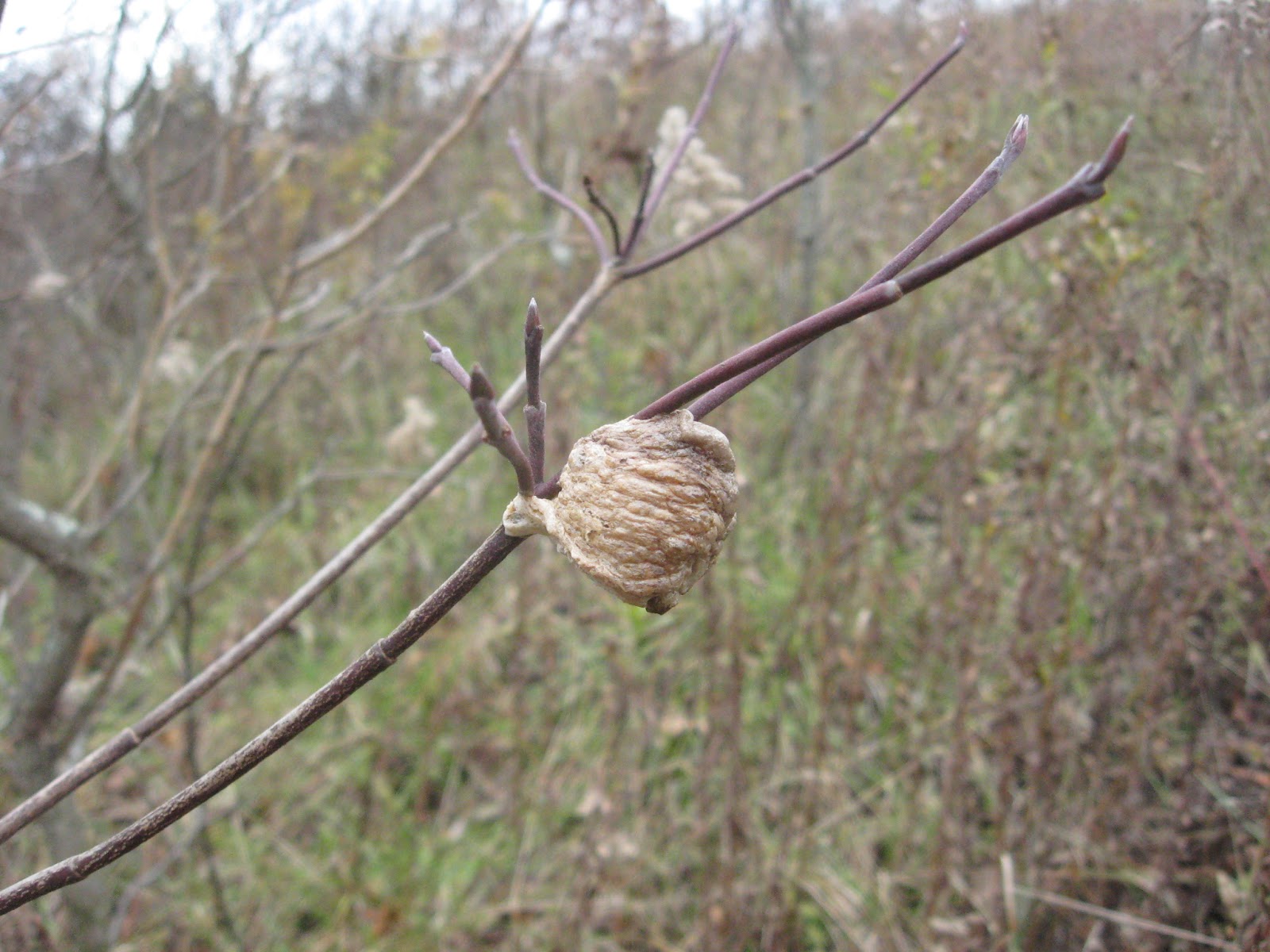
I had been keeping a few praying mantids (Chinese mantids to be specific) in my room and in the College's science building, so I knew exactly what I was looking at: a mantis egg sac. The mantis deposits its eggs and covers them in a foam-like substance, resulting in what you see above. The sac protects the eggs inside from the elements, and once Spring comes around, the eggs hatch, resulting in a mass of about 100 little praying mantids. It's fascinating stuff. I clipped this twig and took the egg sac back with me, and it actually hatched about a month later, resulting in this:

I had to remove the container from my room the day after the mantids hatched, due to the complaints of my fellow dorm dwellers.
Time was running out while I was in the field, so I had to make the most of the time I had remaining. I headed over to the felled trees, finding lichens and mushrooms growing around and on the decaying wood. I tore off a few layers of the bark, and found a neat little ecosystem within the decaying wood. I found some small beetles, and a few beetle grubs inside, feeding on the wood and whatever else was there.

Larva of a fire colored beetle, in the family Pyrochroidae

Another bumblebee, which did not appreciate being touched.

Teasel, genus Dipsacus. Not the best thing to grab onto, but a decent comb.

Finishing up
Now, remember back to when I told you that we left our car parked near the base of the road and out of our sight. We forgot to turn off the headlights, so the battery died and we had to wait about a half hour for a friend to come help us jump start the car. That was a bit embarrassing and not the best end to our adventure, but it could have been worse!
Subscribe to:
Posts (Atom)