Wednesday, November 23, 2011

A Native Ladybug AND Ant-mimic?! No way!

It's not all that often when I find a ladybug (or to be more correct, lady beetle, since it's in the order Coleoptera and not Hemiptera) that isn't the invasive multicolored Asian lady beetle. So when I do, I get pretty excited. I get pretty disappointed when I see invasive organisms dominating the landscape, but when some interesting natives that I've never encountered before pop up, I'm apt to jump up and down in joy (ask anyone who's been out in the field with me).

Last month on a botany trip around campus, our group stopped to examine a black locust (Robinia pseudoacacia). My attention quickly wandered away from me and I found myself examining the other plants around the black locust, leading me to find some arthropods (woohoo!). One looked like an ant, but my previous experience during the summer taught me not to be too certain, so I caught it and pulled out my hand lens to take a closer look.

Imposter!

Not an ant, but rather an ant-mimic! This is actually a jumping spider (Family Salticidae), Synemosyna formica. It looks like the spider has three segments of its body like an insect, head-thorax-abdomen, but since it's a spider, it only has two: a cephalothorax and an abdomen. In order to look more like an ant, the cephalothorax is constricted, giving it the illusion of having three body segments. Now that's some fine Batesian mimicry!

The second arthropod I found hanging around the underbrush was one of our native lady beetles: Psyllobora vigintimaculata. Let's break down that etymology! Psyllo is Greek for flea, and it is quite small; bora is Greek for northern, referring to its habitat distribution. (This is the only species in the genus that you can find in the northeast.) The specific epithet vigintimaculata simply means 20 spotted. If we put it all together, we learn that this species is a small lady beetle that has a northern distribution (though it also occurs in the southern US) and has 20 spots. That's some useful information to know.

Not the largest lady beetle you'll find...

It wasn't exactly the easiest insect to spot, but it was crawling around on the same leaf as the spider, so it was easy to catch both of them. Now, that picture doesn't really help you understand what this beetle looks like....sure, it's white with black spots, maybe a touch of orange, and small, but come on. A hand lens isn't going to cut it. To the dissecting microscope!

Now that's what I'm talking about!

Now we can make more sense of what it looks like. You can see the 20 spots, the texture of the shell, and what it looks like underneath. The anatomy can only tell us so much about the species, so to learn more about how it lives, let's turn to a paper published in 2009 by Sutherland and Parrella (citation can be found at the end of this post). It turns out that this lady beetle (and the others in its subfamily Halyziini) isn't predacious like most other lady beetles, nor does it eat leaves: it feeds on various mildew fungi. These are fungi in the order Erysiphales, which cause powdery mildew diseases in plants, hence their common name. 

Powdery mildew disease is of economic importance in agriculture, and is the main reason why Sutherland and Parrella undertook their study. They found that P. vigintimaculata is a generalist that feeds upon a range of fungi species, and that its density in the environment increased with a greater density of mildew. That's pretty good news for an integrated pest management plan, according to their paper.

They also had a figure showing the beetle's life cycle, which follows. Note that in this study, they used a subspecies, Psyllobora vigintimaculata taedata, so that's what is being referred to. 

Figure 1 from Sutherland and Parrella. (Click to enlarge)

If you see any of those crawling around on your plants, then you've got this species. Note that the adults overwinter under leaves and other secluded spaces (and warmer areas....well, as warm as you can get during winter), so you could be finding them in early Spring. 

Just in case you notice some plants showing signs of mildew disease, look around for this little lady beetle. It's another way in which insects are working in our favor without asking anything in return. Isn't that great? Be sure to keep this in mind the next time you encounter multicolored Asian lady beetles seeking shelter in your home and remember: not all lady beetles are a nuisance!

Citation:
Sutherland, Andrew M.; Parrella, M. P. “Biology and Co-Occurrence of Psyllobora vigintimaculata taedata (Coleoptera: Coccinellidae) and Powdery Mildews in an Urban Landscape of California.” Annals of the Entomological Society of America, v. 102 issue 3, 2009, p. 484-491.

Saturday, November 19, 2011

Hackberry: The Teenage Years

I was going through some of my photos from this past summer (preparing to organize and identify them), when I came across a picture of a tree with some very interesting bark.


I had a vague feeling of recognition when I took this picture, but I couldn't quite pin it down. After being a teaching assistant for a botany class this semester, however, I remembered what it was the second time around: American hackberry (Celtis occidentalis).

What's the easiest way to remember this tree? Definitely the bark: it's gnarled and warty, with furrows. As the tree gets older, it gets more warty and just a tad bit smoother. It hasn't reached this stage yet, so I would call this tree a teenager. 

The leaves are serrate (they have little teeth on the edges), and are alternatively arranged on the stem.


American hackberry is found in the West and Midwest, and is relatively common in Ohio. When its leaves fall off in the autumn, you can sometimes find galls on the leaves caused by a Psyllid insect (it's related to cicadas and aphids). Due to these little insects, the leaves can become as warty as the bark! For more information about the galls, check out the University of Nebraska-Lincoln Extension site.

Interestingly enough, this tree has been in my backyard for a while now and I never noticed it before. If you haven't found a theme from my blog yet, consider this: get out there and start observing! There's still so much to explore.

Saturday, November 12, 2011

Chronicles of Ignorance: Wheel Bug Edition

Regular readers should know by now: I freaking love wheel bugs.

Click that picture to enlarge it, sit back, and really look at it for a while. There's no way you'll ever convince me that's not one of the most beautiful creatures in the world.

So when I catch wind of the wheel bug being talked about in a negative light, I try to set the record straight. Unfortunately, this time, I could not set the record straight. This link will take you to the website for a local news station serving Pittsburgh, WTAE. The video on the page talks about the wheel bug and how one resident discovered one in her yard and was a little frightened. 

Rather than trying to dissuade her of her fears, however, the news team proceeds to FLIP OUT. In what can only be described as an egregious example of shoddy journalism dipped in a vat of ignorance, the video goes on a two minute rampage warning about the dangers of the wheel bug and showing pictures of it to random people on the street, delighting in their faces of horror. 

If you're a fan of insects and nature, or can at least appreciate their merits, you should be offended and disgusted. The video makes no attempt to cast the bug in a positive light, focusing on the slight chance that it can bite people. It's obvious that this was simply a filler story to scare people about the next "insect menace," after the bed bugs of this past summer. 

A news organization should have more integrity than this, focusing on education over fear mongering. It's a disservice to the general public and should not be tolerated. Allowing media like this to be broadcast will only increase the general public's lack of knowledge and misconceptions about the enormous importance of insects. 

In pursuit of remedying this, I have contacted the news station to express my discontent. If you feel the need to follow suit, just click here. The only information they request from you is your name and e-mail. Just make sure to tell them that you would be more than happy to assist them in setting the record straight, or you can redirect them to me.

Tuesday, October 4, 2011

Fluorescent Millipedes? Sweet!

Just a quick post here to highlight one of the more interesting things I've found lately: millipedes that glow under UV light. I've been busy with my Investigative Studies Project, Capstone, and other related endeavors, so I'm essentially stockpiling a lot of photos and information for blog posts during winter, when I won't be finding nearly as much arthropod stuff.

You think you have to go to the rainforest to find neat stuff? HA!

I took a UV flashlight out to the field a few weeks ago and looked through the leaf litter--it was crawling with these many-legged critters. I could barely contain myself, it was just so neat. There were a few species fluorescing under the light, which is a result of a chemical in their exoskeleton, and the fluorescence was at bright as firefly bioluminescence. 

The millipedes were a nice size, hovering around one inch, and had chemical defenses. I grabbed a few to hold in my hand and could smell a slightly sweet scent on my palm after I returned them to the leaf litter. Chemical defenses, UV fluorescence....will millipedes ever stop being exciting? Nope.

Update (Jan 7, 2012): This millipede is Semionellus placidus, which is in a tribe that occurs mostly in the Northwest of North America. I'll try to gather more information and put that together for another post.

One of my next projects? Research the relationship between assassin bugs of a certain subfamily (Ectrichodiinae) and millipedes. Why? Some species in this subfamily are known to be millipede hunters. Maybe this holds true for our local species as well. The only genus around here in the subfamily Ectrichodiinae is Rhiginia, and I had the pleasure of finding the species Rhiginia cruciata during early summer. That gives me a good six months to prepare. Perhaps the millipedes have some dangerous predators to watch out for.

Scarlet-bordered assassin bug, Rhiginia cruciata. Millipede hunter?
 

Wednesday, September 7, 2011

A Strange Place for a Centipede

I had an unexpected encounter with a centipede today around lunchtime. I walked into the restroom and glanced down at the floor, where I found an inch-long centipede....and I was pretty excited. Unfortunately, it was dead, probably due to being stepped on. If nothing else though, that made collecting it easy for me. Have you ever tried to catch a fleeing centipede? They're ridiculously fast and not an easy catch.

After putting it in a plastic bag for safekeeping and eating some lunch, I headed off to the lab, grabbed my centipede ID guide, and threw it under a microscope.

It's a little intimidating, measuring out to about an inch long.

Earlier this summer, I attended an advanced naturalist workshop at the Edge of Appalachia preserve in West Union, Ohio that focused on the centipedes and millipedes (and isopods), which gave me the skills I needed to tackle Myriapoda identification. It was led by Bill Shear, from Hampden-Sydney College in Virginia, and boy did he know a lot about the Myriapods. He was kind enough to hand out some ID guides, which is what I've been using since then to figure out what all these leggy creatures are.


I'm always impressed with what I see when I put a centipede under the microscope. There are so many little structures that you completely miss out on until you magnify them, and they're super interesting. It's almost like you're looking at an entirely new animal.

That's a lot of legs. Centipedes have one pair per segment, while millipedes have two pairs per segment.

This centipede has 15 pairs of legs, and even more antennae segments--more than 35 (I haven't been able to get a final count yet). Not all of its legs are there: a good number broke off, including some of the posterior legs, which are important for identification purposes. An interesting fact: centipedes always have an odd number of leg pairs.

A close-up of the centipede's maxillipeds, which have fangs on the end of them that inject venom. You can see an oval outline on the left side of the maxilliped, which I believe is the centipede's venom gland.

Centipedes are predators: they're quick, and they also have fangs. These fangs are found at the end of the centipede's maxillipeds, which are actually a pair of modified legs (whoa!). The venom glands are contained within these maxillipeds, and work in short order to paralyze and kill its prey. Generally, a bite from a centipede from North America won't hurt too much since they're relatively small compared to a human. But there are some species in the southwestern United States and Mexico that are more dangerous, such as those in the genera Bothropolys, Lithobius, and Neolithobius, which are large centipedes.

The fangs and coxosternal toothplates, with teeth.

Due to the rough shape this centipede was in when I found it, I haven't been able to nail down its ID further than Family Lithobiidae. Currently, family designations for the Order Lithobiomorpha are in flux, with only two families officially recognized--Lithobiidae and Henicopidae. There's definitely room for improvement, and the group is waiting for someone to tackle it.

 Ventral view of the centipede, with coxal pores circled.

An interesting part of centipede anatomy (and a useful characteristic for identification) are the coxal pores, located at the bases of the posterior legs. These pores are connected to coxal glands, which are used for nitrogenous waste excretion.

Make sure to be on the lookout for centipedes and millipedes where ever you are: once you start looking, you'll start seeing them everywhere. The world of the Myriapods is surprisingly vibrant: chemical defenses, parental care, and even bioluminescence characterize many species. It would be a shame to ignore it.

References:

Shear and Weaver. 2007. Keys to the Centipeds of Virginia and Adjacent Regions.

Friday, August 12, 2011

Science Video Friday: Neil deGrasse Tyson on the future of science funding

If you're looking for someone who's passionate about science, you don't have to look any further than Neil deGrasse Tyson, the director of the Hayden Planetarium in New York. This week's Science Video Friday features him articulating why the government funding science is important, even in tough times.

Saturday, August 6, 2011

Aquatic Beetles in a Wheelbarrow

When I think of beetles, what comes to mind are ladybugs, ground beetles, fireflies...maybe stag beetles. All of these are terrestrial beetles and are pretty neat, but why stop at land? There are a number of aquatic beetles that are just as cool, and can be found in rivers, streams, and standing water.

I was canvasing my yard the other day when I came upon a wheelbarrow that was full of standing water. I've checked it a few times before for insects, but usually only find mosquito larvae. Last summer I did find one aquatic beetle, but I never got around to investigating what it was.

When I checked it this time, however, I found a much more diverse assemblage of creatures.

 Acilius mediatus

The orange you see in that picture is rust, while the green gelatinous stuff is an egg covering from one of the species of aquatic beetles in the wheelbarrow. Either that or it's algae or something similar. The beetle Acilius mediatus is in the family Dytiscidae, the predacious diving beetles. You can see its hindlegs, which it uses as oars to swim through the water. I watched the beetle for a little while, and from time to time it would swim up to the water surface, thrust the back of its abdomen out of the water, then swim back down to the depths, hiding under debris. By doing that, the beetle grabs an air bubble and traps it under its elytra, using it as a physical gill. That's wild! The word for this bubble is also one of my favorite biology terms: a plastron. 

A brighter picture, with size comparison to a penny. The beetle about 12 mm long.


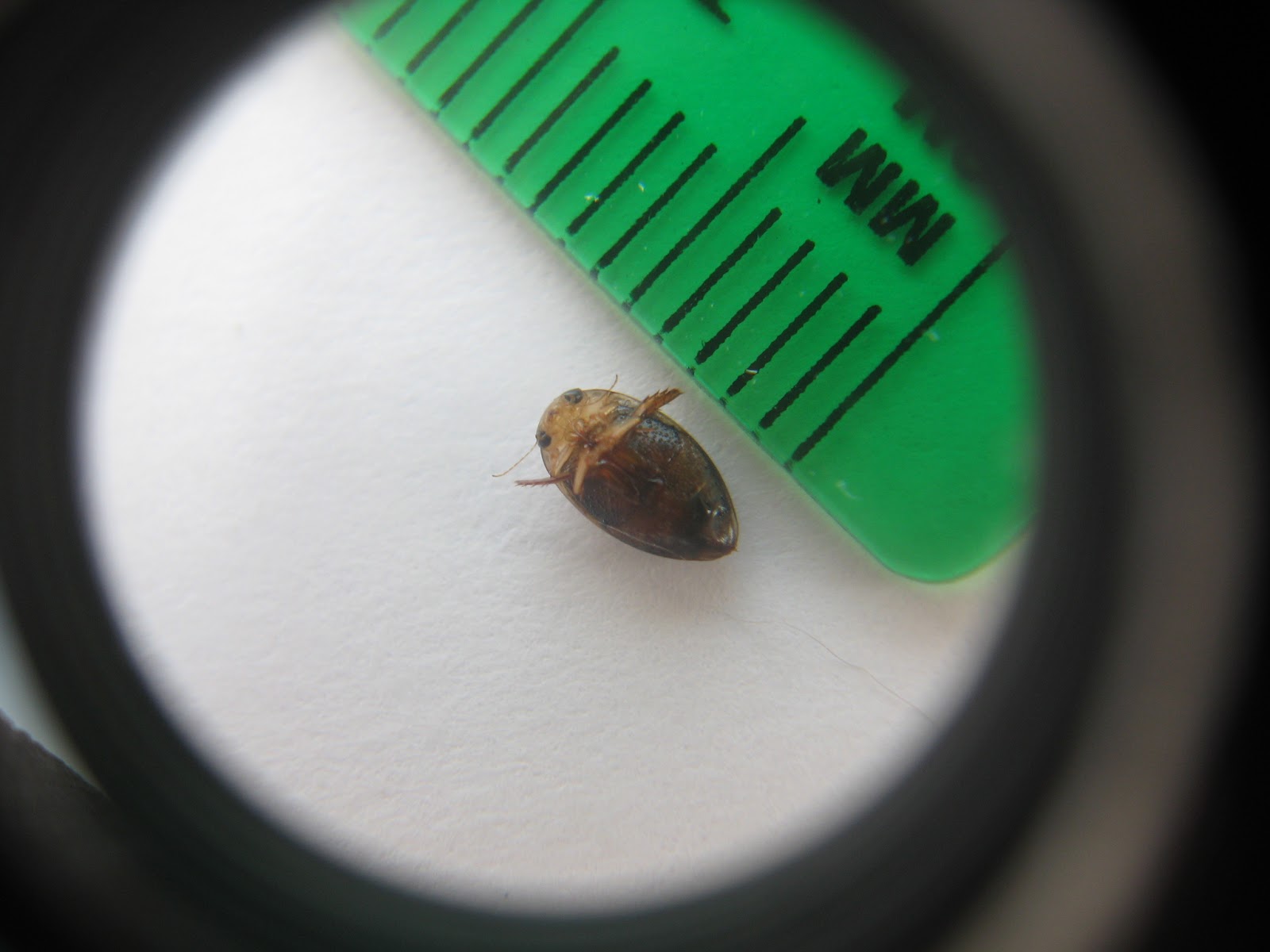
This isn't the clearest picture, but you can see more of the green gelatinous stuff. You can also see small black beetles. I'm not sure what those are, so I'll probably collect a few specimens soon.

 I was also able to learn a little more about the aquatic beetle I saw in the wheelbarrow last summer and collected one of them. Contrary to what I thought at first, the second beetle is NOT in the family Noteridae. Rather, like the previous beetle, it's in the family Dytiscidae.

 A small beetle, only about 5 mm long.


This beetle also has its hind legs modified for swimming, and utilizes a plastron as well. It might be in the genus Laccophilus, but that remains to be seen. UPDATE: This beetle is indeed in the genus Laccophilus, it's the species Laccophilus fasciatus.

As I was watching these beetles, I started wondering how they got into the wheelbarrow in the first place. I hadn't figured it out, so in the meantime I was trying to get a better picture of the beetle I collected. I had it in a small dish of water and picked it up, causing it to slide around frantically in my hand. 

Then it spread its wings and flew out of my hand. 

Oh. 

So that's how they get around to new bodies of water. Yeah, that makes sense. 

Beetles in the family Dytiscidae are predacious in the adult stage, so who knows how much longer they'll all be alive. Especially the smaller beetles, with that huge Acilius mediatus hanging around. I'll have to go back in a few days and see.


Unfortunately, this treehopper (Membracidae: Thelia bimaculata) was not able to thrive in the aquatic environment as well the beetles do.